How to Talk Care of Baby Snapping Turtules
Putting an alligator in your tank may be a tempting choice but it's not a very practical one.
But what if you had a chance to get as close to owning a crocodile as possible? That's where snapping turtles come in!
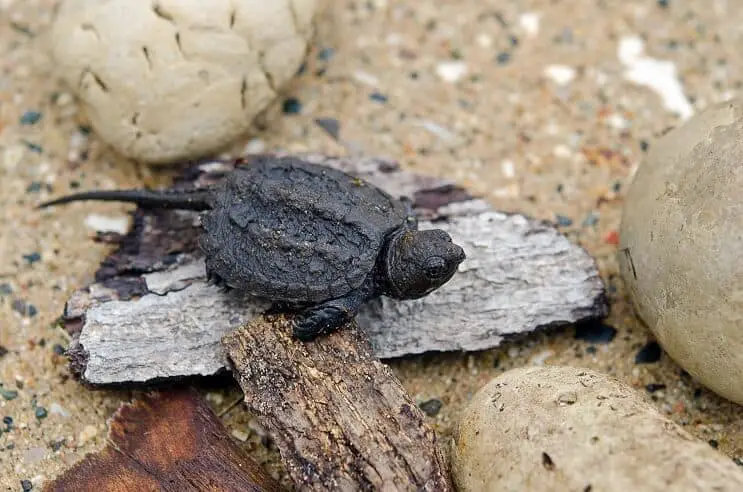
Baby snapping turtles are definitely one of the most exotic pets out there, and their appearance only proves this point. Although they may look scary at first, they are actually very exciting animals to watch, especially in the tank.
You can keep these turtles in an aqua-terrarium. Keep reading to learn all you need to know about the baby snapping turtle!
Advertisements
Baby Snapping Turtle Facts & Overview
| Category | Rating |
| Care Level: | Intermediate |
| Temperament: | Agressive |
| Color Form: | Dark brown |
| Lifespan: | Up to 40 years |
| Size: | Up to 20 inches |
| Diet: | Omnivore |
| Family: | Chelydridae |
| Minimum Tank Size: | Over 100 gallons |
| Tank Set-Up: | Freshwater aqua-terrarium |
| Compatibility: | No |
A common snapping turtle (Chelydra serpentina) is a species of freshwater turtle native to the swamps and rivers of Central, North, and South America. It is a part of Chelydridae family, also commonly known as the family of snapping turtles.
The most popular variety is the common snapping turtle and this care guide will mainly focus on that species, although all species have very similar care needs.
Advertisements
'Serpentina' is its scientific name, which is derived from the word 'serpent'. This might be because of the turtle's aggressive temperament which resembles that of a snake.
When handled incorrectly, snapping turtles can easily bite their owner by turning their head nearly all the way around. They are just as snappy as their name suggests.
These turtles can live for a very long time, around 35-40 years. This all comes down to the quality of care, and whether you have the space to keep such a huge turtle at home.
Although turtles are quite an exotic choice, there is no shortage of them. If you wish to buy one, your best bet is an online store. Online baby turtles will be priced at around $15 for those that are less than 3 inches in length.
Typical Behavior
The cute appearance of baby snapping turtles might trick you into believing that they are pure innocence. Unfortunately, this couldn't be further from the truth.
Common snapping turtles are aggressive predators. In the wild, these animals are usually found alone. If two of them ever get into a dispute, only one is coming out alive.
They spend most of their time in the water, which is where they feel most comfortable. In a tank, their behavior is very similar. You will see them swimming around, as well as relaxing on the above-water parts of your tank.
In the wild, snapping turtles tend to burrow into the substrate when they hibernate, but this is not something they are likely to do in the tank.
Appearance
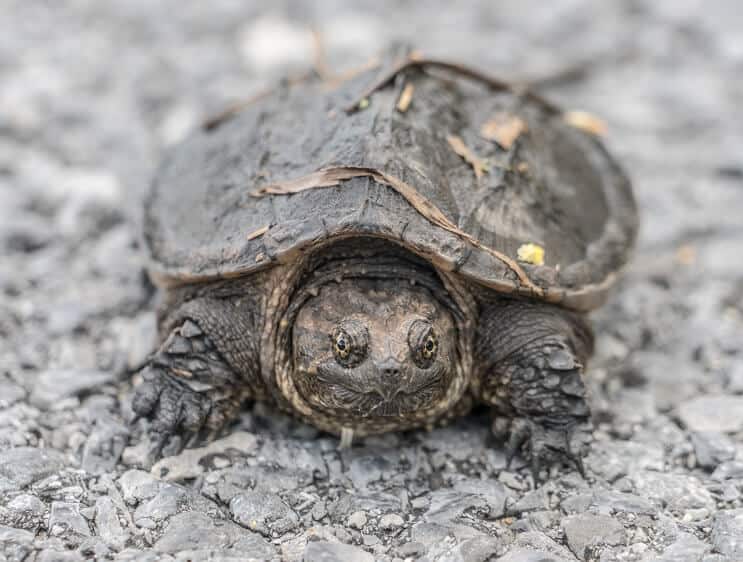
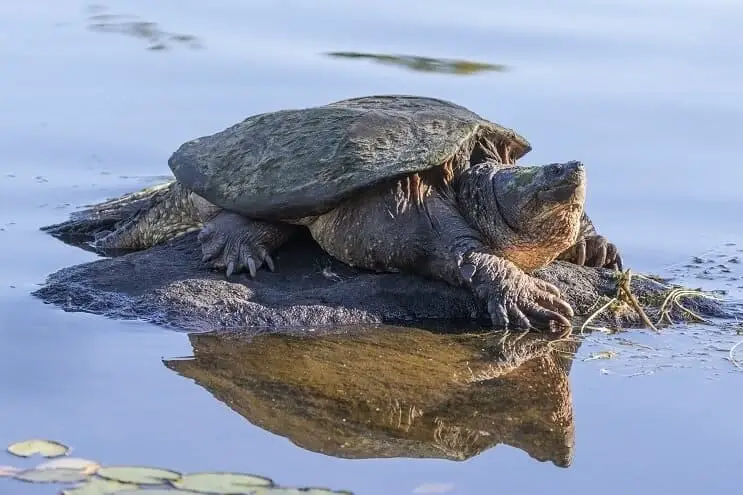
Snapping turtles can grow to an enormous size – as large as 18-20 inches and weigh up to 75lb.
However, the average snapping turtle will reach around 15 inches in length and weigh around 35lb.
Advertisements
To the untrained eye, it can be hard to distinguish between different members of the Chelydridae family, but this turtle has some unique features.
- Their belly shell (scientifically known as the plastron) is very narrow and cross-shaped.
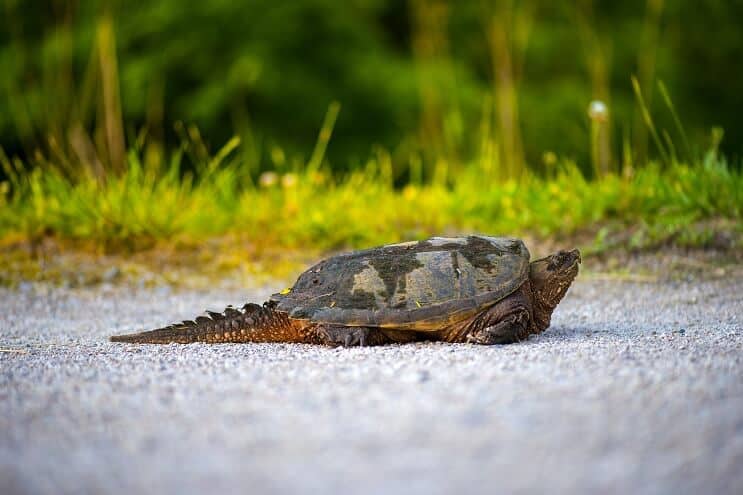
- Their shell has three long short ridges running lengthwise. They have strong webbed feet with sharp claws and a long jagged tail.
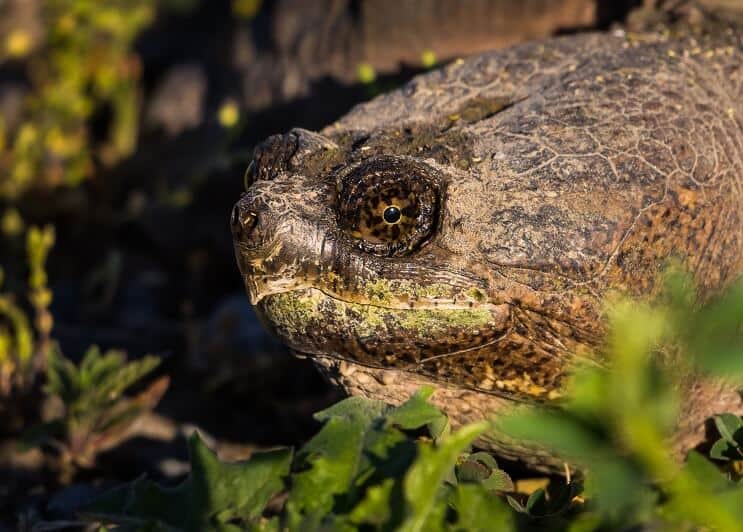
- Their head is large with small black eyes- what instantly catches your eye is their sharp and powerful beak.
- Their shell and soft exposed body parts are dark brown or slightly yellowish. In their belly region, you will often see mixed brown and olive stains – the same pattern is also present along the sides of their main upper shell.
This turtle is commonly confused with an alligator snapping turtle (Macrochelys teminckii).
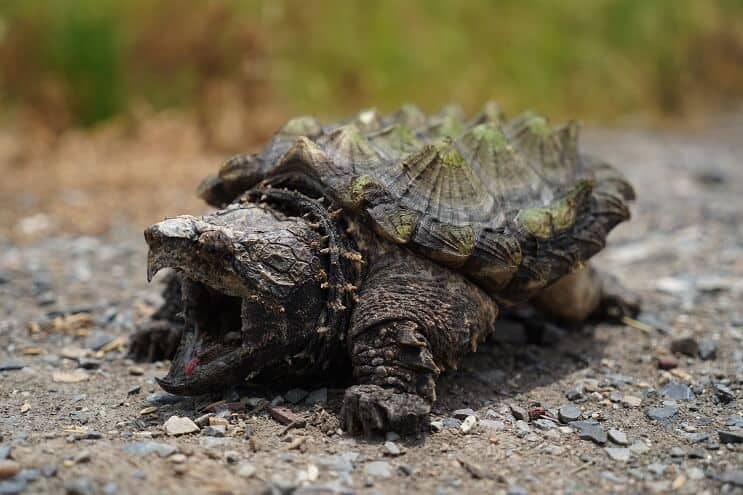
Although they may look similar, the alligator snapping turtle is significantly larger and can reach up to 250 lbs and 32 inches in length. Their shell, unlike the common snapping turtle, has three rows of tall, easily distinguishable crests.
Advertisements
Habitat and Tank Conditions
Snapping turtles are widely distributed across America. They can be found all over the Central and Eastern US, with some varieties being found as far north as the Rocky Mountains.
You will also find them in Mexico, Central America, and a small region of South America.
They usually live in swampy areas or rivers with silted beds. This substrate is important because during winter they will burrow themselves into the substrate to hibernate.
This turtle thrives in fresh or brackish water, which has plenty of vegetation for them to hide among. In the wild, snapping turtles spend most of their time in the water.
Baby Snapping Turtle Tank Setup
Recreating their natural environment in a tank is not a difficult task.
First, let's talk about water parameters:
- Luckily, this turtle can tolerate sudden temperature changes and even survive in cold waters.
- However, it's better if you keep it within the range of 76-78°F using a heater. Some deviation from the recommended range is acceptable, but for optimal development stick to the range above.
- As for water hardness and pH, a good acidity range would be 6.8-7.2pH, and with hardness, it's better not to let your water become overly hard or soft.
- The water needs to be deep enough for the turtles to be able to swim, but shallow enough to allow them to sit on the bottom and stretch up their neck to take a breath. A good depth is slightly deeper than the turtle is wide.
Filtration, on the other hand, is crucial for a snapping turtle's well-being. Maintaining a powerful filtration and aeration system is a must. This shouldn't be a major concern at an early age, but when the turtle grows and is fully grown, you can imagine the amount of waste you'll have to deal with. You will also need a system that is capable of biological, mechanical, and chemical filtration.
Lighting is another important aspect. You would normally need to install two lamps: a normal luminescent and a UV lamp.
Most turtles need UVB lamps for the health of their shells, but snapping turtles are an exception and get all of their UVB requirements from their diet. However, they will still benefit from a multi-spectrum lighting system.
If you buy a UV lamp, make sure that the label says UVB 10%. This ensures that the radiation will stay within acceptable limits.
You can also create a basking area in your tank which can be achieved using a large log or buying a basking dock. It is very important to arrange some sort of land in your aqua-terrarium. The turtle will use it to get out of the water from time to time.
In the wild, the riverbed plays a major role in the lifecycle of these animals. Substrate should be thick enough for your turtle to burrow into. We recommend using a mix of rounded sand and gravel and silt as a covering layer.
Finally, placing plants in your tank is not necessary, but if you really want to, we would advise limiting yourself to a couple of plants. You should ensure there is still enough free space in the tank for them to swim around.
Some popular options are hornwort, Java fern, and anacharis.
What Size Aqua-terrarium Do They Need?
When first bought, hatchlings can be kept in a 10-gallon tank. However, they will soon outgrow this tank. Fully grown snapping turtles will need a 150-gallon tank or an outdoor pond.
The rule to follow is ten gallons of water for every one inch of turtle shell.
Baby Snapping Turtle Care
Caring for baby snapping turtles is fairly straightforward, as they are quite strong, healthy, and not susceptible to any particular disease. However, there are still a few important considerations.
First, don't underestimate the importance of a good filtration system. When dealing with large volumes of water and big animals like this, your tank can become dirty very quickly. If that happens, these animals (especially younger ones) can become sick or experience problems with growth.
Even with a good filter, you will still need to clean the tank yourself. Cleaning aqua-terrariums is almost the same as cleaning any other aquarium. Just make sure the land area of the tank is tidy as well.
You will need to change 15-20% of the water every couple of weeks.
Do not pick up snapping turtles unless you really need to. You need to remember that you are still dealing with an aggressive predator, even if it's in the tank. Pick them up by firmly holding the back of their shells, and make sure that they won't be able to bite you. Consider using thick gloves in case something doesn't go to plan!
What To Feed Baby Snapping Turtles
In the wild, snapping turtles will eat almost anything they can catch. In addition to feeding on live prey, they also like to diversify their diet with plants.
All this easily translates into the tank – your snapping turtles can be fed live and artificial foods.
Their diet will depend on their size and age. Baby snapping turtles will eat significantly less than adults. They will happily eat bloodworms, unfrozen pieces of fish, shrimps, diced fruits, and any other meaty foods.
Fruits, however, should be given in moderation as a snack.
When it comes to artificial foods, they can also be fed granules or flakes. It is important to make sure that any artificial foods you buy from the store are suitable for turtles. Granules are a great choice when you don't have time to prepare the food yourself.
Advertisements
Granulated foods will usually have just the right amount of nutrients, so you don't have to worry about the nutritional value of their diet.
Because these turtles are omnivores, part of their diet will be plant-based. If you already have some plants in the tank, great! They will be able to feed on those, just make sure plants are healthy and fresh.
If you don't have any greenery growing in the tank, don't worry. This can be substituted with flakes or any leafy premade foods. As an alternative, you may consider plants from the genus Scindapsus or Monstera.
Feed hatchlings once or twice a day, and feed fully grow species three times a week. If they look like they're bulging out of their shell, feed them less, and if their skin looks saggy, feed them more.
Advertisements
Tank Mates
Because snapping turtles live in such vast territories, they encounter almost every kind of fish in their natural habitat. However, these fish account for one of their main food sources.
As you can imagine, finding something that can live alongside powerful predators is a hard task.
Any slow or sluggish fish should not be considered, as they will undoubtedly end up being eaten. The same goes for bottom-dwelling fish, as they will cross paths with the snapping turtle too often.
If you really want to add fish, choose small and fast fish. However, we really recommend keeping these guys alone. Nearly every fish that you add to the tank will share the same fate.
Keeping any non-fish inhabitants with these snapping turtles is even more complicated. Because non-fish creatures and snapping turtles will both mainly live at the bottom of the tank, fights are bound to happen. In most cases, non-fish tank mates will also end up being eaten.
Advertisements
Keeping Baby Snapping Turtles Together
Snapping turtles are not only a danger to other animals but also to their own species. They can be really aggressive to each other, so we recommend you keep just one per tank.
Conclusion
The common snapping turtle is one of the most ancient and interesting animals you can keep at home.
Baby snapping turtles are quite easy to look after. They are not picky when it comes to food, and they don't require much attention as long as you have a good filter.
However, adults require more care because of their size. If you don't have enough space for a proper turtle tank, it will become a problem.
If you learn to appreciate their nature, they are guaranteed to be one of the best pets you've ever had.
Advertisements
How to Talk Care of Baby Snapping Turtules
Source: https://www.fishkeepingworld.com/baby-snapping-turtle/
0 Response to "How to Talk Care of Baby Snapping Turtules"
إرسال تعليق