Mahler Das Lied Von Der Erda James Levine Berlin Philharmonic Reviews
| Das Lied von der Erde | |
|---|---|
| A Symphony for Tenor, Alto (or Baritone) Vocalisation and Orchestra | |
| Orchestral vocal cycle by Gustav Mahler | |
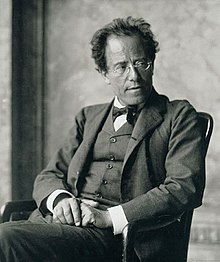 Gustav Mahler in 1907 | |
| Text | From Hans Bethge's Die chinesische Flöte |
| Composed | 1908 (1908): Toblach |
| Published | 1912, Universal Edition |
| Duration | ca. 60 minutes |
| Movements | half dozen |
| Scoring |
|
| Premiere | |
| Date | 20 November 1911 (1911-11-20) |
| Location | Munich Tonhalle, Munich |
| Usher | Bruno Walter |
| Performers | Sara Cahier, William Miller |
Das Lied von der Erde ("The Song of the Earth") is an orchestral vocal bike for 2 voices and orchestra written by Gustav Mahler betwixt 1908 and 1909. Described as a symphony when published, it comprises six songs for two singers who alternating movements. Mahler specified that the two singers should be a tenor and an alto, or else a tenor and a baritone if an alto is not bachelor.[i] Mahler composed this piece of work post-obit the almost painful menstruation in his life, and the songs address themes such as those of living, parting and conservancy. On the centenary of Mahler's birth, the composer and prominent Mahler usher Leonard Bernstein described Das Lied von der Erde as Mahler'due south "greatest symphony".[ii] As with his subsequently Symphony No. nine, Mahler did not alive to hear Das Lied von der Erde performed.
History [edit]
Composition [edit]
Iii disasters befell Mahler during the summertime of 1907. Political maneuvering and antisemitism forced him to resign as Managing director of the Vienna Court Opera, his eldest girl Maria died from scarlet fever and diphtheria, and Mahler himself was diagnosed with a congenital eye defect. "With one stroke", he wrote to his friend Bruno Walter, "I have lost everything I have gained in terms of who I thought I was, and accept to learn my first steps again similar a newborn."[3]
The same year saw the publication of Hans Bethge's Die chinesische Flöte, a complimentary rewriting of others' translations of classical Chinese poems. Mahler was captivated by the vision of earthly dazzler and transience expressed in these verses[four] and chose vii of the poems to set to music as Das Lied von der Erde. Mahler completed the work in 1909.
Mahler was aware of the so-called "curse of the 9th",[5] a superstition arising from the fact that no major composer since Beethoven had successfully completed more than nine symphonies: he had already written eight symphonies before composing Das Lied von der Erde. Fearing his subsequent demise, he decided to subtitle the work A Symphony for Tenor, Alto (or Baritone) Voice and Orchestra, rather than numbering it as a symphony.[6] His next symphony, written for purely instrumental forces, was numbered his 9th. That was indeed the terminal symphony he fully completed, because only portions of the Tenth had been fully orchestrated at the time of his death.
Reception [edit]
The get-go public functioning was given, posthumously, on 20 November 1911 in the Tonhalle in Munich, sung by Sara Cahier and William Miller (both Americans) with Bruno Walter conducting. Mahler had died half-dozen months earlier, on 18 May.[7] 1 of the earliest performances in London (possibly the first) occurred in Jan 1913 at the Queen's Hall under usher Henry Woods, where it was sung past Gervase Elwes and Doris Woodall. Wood reportedly thought that the work was "excessively modernistic simply very beautiful".[viii]
Instrumentation [edit]
Mahler had already included movements for voice and orchestra in his Second, Third, Fourth and 8th Symphonies. However, Das Lied von der Erde is the commencement complete integration of song bicycle form with that of the symphony. The form was afterwards imitated past other composers, notably past Shostakovich and Zemlinsky. This new form has been termed a "song-symphony",[nine] a hybrid of the two forms that had occupied most of Mahler's creative life.
Das Lied von der Erde is scored for a large orchestra, consisting of the following:
Only in the first, fourth and sixth songs does the full orchestra play together. The celesta is merely heard at the end of the finale, and only the first motility requires all three trumpets, with two playing in the 4th movement and none playing in the sixth. In many places the texture resembles chamber music, with only a few instruments existence used at once.[ citation needed ] The score calls for tenor and alto soloists.[1] Even so, Mahler includes the note that "if necessary, the alto part may be sung by a baritone".[x] Mahler also arranged the work for piano accompaniment.[11]
Movements [edit]
1. "Das Trinklied vom Jammer der Erde" [edit]
The first motion, "The Drinking Song of World'south Misery" (in A pocket-size), continually returns to the refrain, Dunkel ist das Leben, ist der Tod (literally, "Nighttime is life, is expiry"), which is pitched a semitone higher on each successive appearance.

Like many drinking poems by Li Bai, the original poem "Bei Ge Xing" (a pathetic song) (Chinese: 悲歌行) mixes drunken exaltation with a deep sadness. The singer's part is notoriously enervating, since the tenor has to struggle at the top of his range against the power of the full orchestra. This gives the voice its shrill, piercing quality, and is consistent with Mahler's practice of pushing instruments, including song cords, to their limits. According to musicologist Theodor W. Adorno, the tenor should hither create the impression of a "denatured vocalization in the Chinese (falsetto) fashion".[12] [13]

The movement begins with a iii-note horn telephone call which recurs throughout the song, most notably at the climax in which the vocalist describes an ape calling "into the sweet fragrance of life." The climax also marks the showtime of the three whole-tone passages that occur in the symphony.
2. "Der Einsame im Herbst" [edit]

"The lonely ane in Autumn" (for alto, in D minor) is a much softer, less turbulent movement. Marked "somewhat dragging and exhausted", it begins with a repetitive shuffling in the strings, followed by solo wind instruments. The lyrics, which are based on the first function of a Tang Dynasty era poem by Qian Qi,[14] complaining the dying of flowers and the passing of dazzler, too as expressing an wearied longing for sleep. The orchestration in this movement is sparse and sleeping room music-similar, with long and independent contrapuntal lines.
3. "Von der Jugend" [edit]

The third movement, "Of Youth" (for tenor, in B ♭ major), is the most manifestly pentatonic and fake-Asian. The form is ternary, the 3rd part beingness a greatly abbreviated revision of the first. It is likewise the shortest of the six movements, and tin can exist considered a starting time scherzo.
iv. "Von der Schönheit" [edit]

The music of this move, "Of Beauty" (for alto, in M major), is mostly soft and legato, meditating on the image of some "young girls picking lotus flowers at the riverbank." Later in the movement there is a louder, more articulated section in the brass equally the young men ride by on their horses. There is a long orchestral postlude to the sung passage, equally the most beautiful of the immature maidens looks longingly later on the most handsome of the immature men.
five. "Der Trunkene im Frühling" [edit]

The second scherzo of the work is provided by the 5th movement, "The drunken man in Spring" (for tenor, in A major). Similar the first, it opens with a horn theme. In this movement Mahler uses an extensive variety of key signatures, which can change as frequently equally every few measures. The heart section features a solo violin and solo flute, which represent the bird the vocalizer describes.
6. "Der Abschied" [edit]
The final movement, "The Farewell" (for alto, from C minor to C major), is nearly as long equally the previous v movements combined. Its text is drawn from two different poems, both involving the theme of get out-taking. Mahler himself added the last lines. This final vocal is too notable for its text-painting, using a mandolin to represent the vocalizer'southward lute, imitating bird calls with woodwinds, and repeatedly switching between the major and small-scale modes to articulate sharp contrasts in the text.
The movement is divided into three major sections. In the kickoff, the vocalist describes the nature around her as night falls. In the 2d, she is waiting for her friend to say a final bye. A long orchestral interlude precedes the third section, which depicts the exchange between the ii friends and fades off into silence.
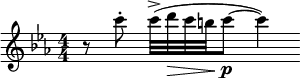
Lines 1–3, 17–19, and 26–28 are all sung to the same music, with a pedal point in the low strings and soft strokes of the tam-tam; in the first two of these sections, a countermelody in the flute imitates the vocal of a bird, but the third of these sections is only the blank pedal point and tam-tam.[ane] The singer repeats the final word of the vocal, ewig ("forever"), like a mantra, accompanied by sustained chords in the orchestra, which features mandolin, harps, and celesta. Ewig is repeated as the music fades into silence, the final 6th chord "printed on the atmosphere" as Benjamin Britten asserted.[15]
It is also worth noting that throughout Das Lied von der Erde there is a persistent message that "The earth volition stay beautiful forever, but man cannot live for even a hundred years." At the terminate of "Der Abschied," yet, Mahler adds 3 original lines which echo this, but purposefully omit the part saying that "man must die".[1] Conductor and composer Leonard Bernstein asserts that this ties in with the Eastern idea of Nirvana, in that the "soul" of the singer, as she or he dies, becomes one with the everlasting earth.[16]

The last motion is very difficult to conduct because of its cadenza-similar writing for voice and solo instruments, which ofttimes flows over the barlines. Mahler specifically instructed the move to be played Ohne Rücksicht auf das Tempo (Without regard for the tempo). Bruno Walter related that Mahler showed him the score of this movement and asked about 1 passage, "Can you remember of a way of conducting that? Because I can't."[17] Mahler likewise hesitated to put the slice earlier the public because of its relentless negativity, unusual fifty-fifty for him. "Won't people become home and shoot themselves?" he asked.[eighteen]
Text [edit]
Mahler's source for the text was Hans Bethge'southward Die chinesische Flöte (1907). Bethge's poems were free adaptations ("Nachdichtungen") of classical Chinese poetry based on prior prose translations into German language (Hans Heilmann'southward Chinesische Lyrik, 1905[19] [twenty]) and French (Marquis d'Hervey de Saint Denys' Poésies de l'époque des Thang, 1862[21] and Judith Gautier'due south Livre de Jade, 1867/1902[22] [23]).[24] [25]
4 of the songs—"Das Trinklied vom Jammer der Erde", "Von der Jugend", "Von der Schönheit" and "Der Trunkene im Frühling"—were derived from poems written by Li Bai, the wandering poet of the Tang dynasty. "Der Einsame im Herbst" is based on a poem "Later on Long Autumn Night" by Qian Qi, another poet of the Tang Dynasty.[14] "Der Abschied" combines poems by Tang Dynasty poets Meng Haoran and Wang Wei, with several additional lines by Mahler himself. These attributions accept been a matter of some uncertainty, and around the turn of the 21st century, Chinese scholars extensively debated the sources of the songs post-obit a functioning of the work in Communist china in 1998.[26]
According to the musicologist Theodor W. Adorno, Mahler found in Chinese poetry what he had formerly sought afterwards in the genre of German folk song: a mask or costume for the sense of rootlessness or "otherness" attention his identity as a Jew.[12] [13] This theme, and its influence upon Mahler's tonality, has been farther explored by John Sheinbaum.[27] It has besides been asserted that Mahler found in these poems an echo of his ain increasing awareness of bloodshed.[28] [29]
The Universal Edition score of 1912 for Das Lied von der Erde shows Mahler's adjusted text as follows.
1. "Das Trinklied vom Jammer der Erde" ("The Drinking Song of World'southward Sorrow") [edit]
Schon winkt der Wein im gold'nen Pokale,
Doch trinkt noch nicht, erst sing' ich euch ein Lied!
Das Lied vom Kummer
Soll auflachend in die Seele euch klingen.
Wenn der Kummer naht,
Liegen wüst die Gärten der Seele,
Welkt hin und stirbt die Freude, der Gesang.
Dunkel ist das Leben, ist der Tod.
Herr dieses Hauses!
Dein Keller birgt die Fülle des goldenen Weins!
Hier, diese Laute nenn' ich mein!
Die Laute schlagen und die Gläser leeren,
Das sind dice Dinge, die zusammen passen.
Ein voller Becher Weins zur rechten Zeit
Ist mehr wert, als alle Reiche dieser Erde!
Dunkel ist das Leben, ist der Tod!
Das Firmament blaut ewig und dice Erde
Wird lange fest steh'due north und aufblüh'northward im Lenz.
Du aber, Mensch, wie lang lebst denn du?
Nicht hundert Jahre darfst du dich ergötzen
An all dem morschen Tande dieser Erde!
Seht dort hinab! Im Mondschein auf den Gräbern
Hockt eine wild-gespenstische Gestalt –
Ein Aff' ist's! Hört ihr, wie sein Heulen
Hinausgellt in den süßen Duft des Lebens!
Jetzt nehmt den Wein! Jetzt ist es Zeit, Genossen!
Leert eure gold'nen Becher zu Grund!
Dunkel ist das Leben, ist der Tod!
The wine beckons in golden goblets
merely drink not yet; first I'll sing you a song.
The vocal of sorrow
shall ring laughingly in your soul.
When the sorrow comes,
blasted lie the gardens of the soul,
wither and perish joy and singing.
Dark is life, dark is decease!
Principal of this house,
your cellar is total of golden wine!
Here, this lute I call mine.
The lute to strike and the glasses to drain,
these things become well together.
A full goblet of wine at the right fourth dimension
is worth more than all the kingdoms of this globe.
Nighttime is life, night is expiry!
The heavens are always blueish and the Globe
shall stand up certain, and blossom in the bound.
But y'all O man, what long life have you?
Not a hundred years may you delight
in all the rotten baubles of this globe.
Come across down at that place! In the moonlight, on the graves
squats a wild ghostly shape;
an ape it is! Hear you his howl get out
in the sweet fragrance of life.
At present! Drink the vino! Now it is time comrades.
Drain your gilded goblets to the last.
Dark is life, night is death!
(Chinese original version of this verse form: 悲歌行.
two. "Der Einsame im Herbst" ("The Solitary One in Fall") [edit]
Herbstnebel wallen bläulich überm Run into;
Vom Reif bezogen stehen alle Gräser;
Man meint, ein Künstler habe Staub von Jade
Über die feinen Blüten ausgestreut.
Der süße Duft der Blumen ist verflogen;
Ein kalter Current of air beugt ihre Stengel nieder.
Bald werden die verwelkten, gold'nen Blätter
Der Lotosblüten auf dem Wasser zieh'n.
Mein Herz ist müde. Meine kleine Lampe
Erlosch mit Knistern, es gemahnt mich an den Schlaf.
Ich komm' zu dir, traute Ruhestätte!
Ja, gib mir Ruh', ich hab' Erquickung not!
Ich weine viel in meinen Einsamkeiten.
Der Herbst in meinem Herzen währt zu lange.
Sonne der Liebe willst du nie mehr scheinen,
Um meine bittern Tränen balmy aufzutrocknen?
Autumn fog creeps bluishly over the lake.
Every blade of grass stands frosted.
Equally though an artist had jade-dust
over the fine flowers strewn.
The sweetness fragrance of flower has passed;
A cold wind bows their stems low.
Soon will the wilted, gilt petals
of lotus flowers upon the water float.
My heart is tired. My lilliputian lamp
expired with a crepitation, minding me to slumber.
I come to you, trusted resting identify.
Aye, requite me rest, I have demand of refreshment!
I cry often in my loneliness.
Fall in my center lingers as well long.
Lord's day of love, will you no longer shine
Gently to dry up my bitter tears?
3. "Von der Jugend" ("Of Youth") [edit]
Mitten in dem kleinen Teiche
Steht ein Pavillon aus grünem
Und aus weißem Porzellan.
Wie der Rücken eines Tigers
Wölbt die Brücke sich aus Jade
Zu dem Pavillon hinüber.
In dem Häuschen sitzen Freunde,
Schön gekleidet, trinken, plaudern.
Manche schreiben Poesy nieder.
Ihre seidnen Ärmel gleiten
Rückwärts, ihre seidnen Mützen
Hocken lustig tief im Nacken.
Auf des kleinen Teiches stiller
Wasserfläche zeigt sich alles
Wunderlich im Spiegelbilde.
Alles auf dem Kopfe stehend
In dem Pavillon aus grünem
Und aus weißem Porzellan;
Wie ein Halbmond steht die Brücke,
Umgekehrt der Bogen. Freunde,
Schön gekleidet, trinken, plaudern.
In the middle of the little swimming
stands a pavilion of dark-green
and white porcelain.
Similar the dorsum of a tiger
arches the jade bridge
over to the pavilion.
Friends sit in the fiddling house
well dressed, drinking, chatting.
some writing verses.
Their silk sleeves glide
backwards, their silk caps
rest gaily at the napes of their necks.
On the pocket-sized pond's still
surface, everything shows
whimsical in mirror image.
Everything stands on its head
in the pavilion of green
and white porcelain.
Like a half-moon is the bridge
its arch upturned. Friends
well dressed, drinking, chatting.
4. "Von der Schönheit" ("Of Beauty") [edit]
Junge Mädchen pflücken Blumen,
Pflücken Lotosblumen an dem Uferrande.
Zwischen Büschen und Blättern sitzen sie,
Sammeln Blüten in den Schoß und rufen
Sich einander Neckereien zu.
Gold'ne Sonne webt um dice Gestalten,
Spiegelt sie im blanken Wasser wider,
Sonne spiegelt ihre schlanken Glieder,
Ihre süßen Augen wider,
Und der Zephir hebt mit Schmeichelkosen
Das Gewebe Ihrer Ärmel auf,
Führt den Zauber
Ihrer Wohlgerüche durch die Luft.
O sieh, was tummeln sich für schöne Knaben
Dort an dem Uferrand auf mut'gen Rossen?
Weithin glänzend wie die Sonnenstrahlen;
Schon zwischen dem Geäst der grünen Weiden
Trabt das jungfrische Volk einher!
Das Roß des einen wiehert fröhlich auf
Und scheut und saust dahin,
Über Blumen, Gräser wanken hin dice Hufe,
Sie zerstampfen jäh im Sturm die hingesunk'nen Blüten,
Hei! Wie flattern im Taumel seine Mähnen,
Dampfen heiß die Nüstern!
Gold'ne Sonne webt um die Gestalten,
Spiegelt sie im blanken Wasser wider.
Und die schönste von den Jungfrau'northward sendet
Lange Blicke ihm der Sehnsucht nach.
Ihre stolze Haltung ist nur Verstellung.
In dem Funkeln ihrer großen Augen,
In dem Dunkel ihres heißen Blicks
Schwingt klagend noch die Erregung ihres Herzens nach.
Young girls picking flowers,
Picking lotus flowers at the riverbank.
Amidst bushes and leaves they sit down,
gathering flowers in their laps and calling
one another in raillery.
Golden lord's day plays well-nigh their form
reflecting them in the articulate water.
The sun reflects back their slender limbs,
their sweet eyes,
and the breeze teasing upwardly
the warp of their sleeves,
directs the magic
of perfume through the air.
O see, what a tumult of handsome boys
at that place on the shore on their spirited horses.
Yonder shining like the sun's rays
between the branches of green willows
trot along the bold companions.
The equus caballus of one neighs happily on
and shies and rushes there,
hooves shaking downwards blooms, grass,
trampling wildly the fallen flowers.
Hei! How frenzied his mane flutters,
and hotly steam his nostrils!
Golden lord's day plays virtually their form
reflecting them in the clear water.
And the near beautiful of the maidens sends
long looks adoring at him.
Her proud pose is but a pretense;
in the flash of her large optics,
in the darkness of her ardent gaze
beats longingly her burning heart.
若耶溪旁采莲女,
笑隔荷花共人语。
日照新妆水底明,
风飘香袂空中举。
岸上谁家游冶郎,
三三五五映垂杨。
紫骝嘶入落花去,
见此踟蹰空断肠。
(Chinese original version of this verse form: 采莲曲 (李白) ( Wikisource).
5. "Der Trunkene im Frühling" ("The Drunkard in Leap") [edit]
Wenn nur ein Traum das Leben ist,
Warum denn Müh' und Plag'!?
Ich trinke, bis ich nicht mehr kann,
Den ganzen, lieben Tag!
Und wenn ich nicht mehr trinken kann,
Weil Kehl' und Seele voll,
So tauml' ich bis zu meiner Tür
Und schlafe wundervoll!
Was hör' ich beim Erwachen? Horch!
Ein Vogel singt im Baum.
Ich frag' ihn, ob schon Frühling sei,
Mir ist als wie im Traum.
Der Vogel zwitschert: Ja!
Der Lenz ist da, sei kommen über Nacht!
Aus tiefstem Schauen lauscht' ich auf,
Der Vogel singt und lacht!
Ich fülle mir den Becher neu
Und leer' ihn bis zum Grund
Und singe, bis der Mond erglänzt
Am schwarzen Firmament!
Und wenn ich nicht mehr singen kann,
So schlaf' ich wieder ein.
Was geht mich denn der Frühling an!?
Laßt mich betrunken sein!
If life is but a dream,
why work and worry?
I drink until I no more can,
the whole, blessed day!
And if I can beverage no more than
as throat and soul are full,
and so I stagger to my door
and sleep wonderfully!
What practise I hear on waking? Hark!
A bird sings in the tree.
I ask him if it's spring already;
to me it's as if I'one thousand in a dream.
The bird chirps Aye!
The spring is here, it came overnight!
From deep wonderment I heed;
the bird sings and laughs!
I fill my loving cup anew
and drink information technology to the lesser
and sing until the moon shines
in the black firmament!
And if I can not sing,
then I fall asleep again.
What to me is bound?
Let me exist drunk!
(Chinese original version of this poem: 春日醉起言志 ( Wikisource).
half dozen. "Der Abschied" ("The Adieu") [edit]
Dice Sonne scheidet hinter dem Gebirge.
In alle Täler steigt der Abend nieder
Mit seinen Schatten, die voll Kühlung sind.
O sieh! Wie eine Silberbarke schwebt
Der Mond am blauen Himmelssee herauf.
Ich spüre eines feinen Windes Weh'north
Hinter den dunklen Fichten!
Der Bach singt voller Wohllaut durch das Dunkel.
Die Blumen blassen im Dämmerschein.
Die Erde atmet voll von Ruh' und Schlaf.
Alle Sehnsucht volition nun träumen,
Dice müden Menschen geh'northward heimwärts,
Um im Schlaf vergess'nes Glück
Und Jugend neu zu lernen!
Die Vögel hocken however in ihren Zweigen.
Die Welt schläft ein!
Es wehet kühl im Schatten meiner Fichten.
Ich stehe hier und harre meines Freundes;
Ich harre sein zum letzten Lebewohl.
Ich sehne mich, o Freund, an deiner Seite
Dice Schönheit dieses Abends zu genießen.
Wo bleibst du? Du läßt mich lang allein!
Ich wandle auf und nieder mit meiner Laute
Auf Wegen, dice von weichem Grase schwellen.
O Schönheit! O ewigen Liebens – Lebens – trunk'ne Welt!
Er stieg vom Pferd und reichte ihm den Torso
Des Abschieds dar.
Er fragte ihn, wohin er führe
Und auch warum es müßte sein.
Er sprach, seine Stimme war umflort. Du, mein Freund,
Mir war auf dieser Welt das Glück nicht agree!
Wohin ich geh'? Ich geh', ich wand're in die Berge.
Ich suche Ruhe für mein einsam Herz.
Ich wandle nach der Heimat, meiner Stätte.
Ich werde niemals in die Ferne schweifen.
Still ist mein Herz und harret seiner Stunde!
Dice liebe Erde allüberall
Blüht auf im Lenz und grünt aufs neu!
Allüberall und ewig blauen licht die Fernen!
Ewig... ewig...
The dominicus departs backside the mountains.
In all the valleys the evening descends
with its shadow, full cooling.
O look! Like a silverish boat sails
the moon in the watery blue heaven.
I sense the fine breeze stirring
backside the dark pines.
The brook sings out clear through the darkness.
The flowers pale in the twilight.
The earth breathes, in total rest and slumber.
All longing now becomes a dream.
Weary men traipse homeward
to sleep; forgotten happiness
and youth to rediscover.
The birds roost silent in their branches.
The globe falls asleep.
It blows coolly in the shadows of my pines.
I stand hither and expect for my friend;
I wait to bid him a last good day.
I yearn, my friend, at your side
to enjoy the beauty of tonight.
Where are you? Yous leave me long solitary!
I walk upwardly and down with my lute
on paths swelling with soft grass.
O beauty! O eternal loving-and-life-bedrunken world!
He dismounted and handed him the drink
of adieu.
He asked him where he would become
and why must information technology be.
He spoke, his voice was tranquillity. Ah my friend,
Fortune was non kind to me in this world!
Where do I go? I go, I wander in the mountains.
I seek peace for my alone heart.
I wander homeward, to my abode!
I'll never wander far.
Withal is my centre, awaiting its hr.
The dear earth everywhere
blossoms in leap and grows green anew!
Everywhere and forever blue is the horizon!
Forever ... Forever ...
Recordings [edit]
Recordings of Mahler'due south orchestral and pianoforte reduction versions.
Orchestra, female and male person soloists [edit]
- Marc Albrecht, with Alice Coote and Burkhard Fritz, Netherlands Combo Orchestra (Pentatone 3530480)
- Daniel Barenboim, with Waltraud Meier and Siegfried Jerusalem, Chicago Symphony Orchestra (Erato CD D-2292-45624-2)
- Eduard van Beinum, with Nan Merriman and Ernst Haefliger, Concertgebouw Orchestra, Amsterdam (Fontana LP 894 120 ZKY)
- Leonard Bernstein, with Christa Ludwig and René Kollo, State of israel Combo Orchestra (Sony CD 88697806222)
- Gary Bertini, with Marjana Lipovšek and Ben Heppner, Cologne Radio Symphony Orchestra (EMI Classics 0946 3 40238 2 v, 11-CD box set)
- Pierre Boulez, with Violeta Urmana and Michael Schade, Vienna Philharmonic (DGG, CD E4695262)
- Colin Davis, with Jessye Norman and Jon Vickers, London Symphony Orchestra (Philips 441 474-two)
- Dietrich Fischer-Dieskau, with Yvi Jänicke and Christian Elsner, Stuttgart Radio Symphony Orchestra (Orfeo C494001B; live recording from 1996)
- Iván Fischer, with Gerhild Romberger and Robert Dean Smith, Budapest Festival Orchestra (Channel Classics CCS SA 40020)
- Michael Gielen, with Cornelia Kalisch and Siegfried Jerusalem, SWR Sinfonieorchester Baden-Baden und Freiburg (SWR Music 93.269)
- Carlo Maria Giulini, with Brigitte Fassbaender and Francisco Araiza, Berlin Philharmonic (DGG CD 413 459-2)
- Carlo Maria Giulini, with Brigitte Fassbaender and Francisco Araiza, Berlin Philharmonic (Testament Records SBT1465; live recording from February 1984)
- Carlo Maria Giulini, with Brigitte Fassbaender and Francisco Araiza, Vienna Combo (Orfeo C 654 052 B; live recording from ii August 1987)
- Hans Graf, with Jane Henschel and Gregory Kunde, Houston Symphony (Naxos 8.527498)
- Bernard Haitink, with Janet Baker and James Rex, Concertgebouw Orchestra, Amsterdam, 1975 (Philips LP 6500 831)
- Michael Halász, with Ruxandra Donose and Thomas Harper, National Symphony Orchestra of Ireland (Naxos 8.550933)
- Jascha Horenstein, with Alfreda Hodgson and John Mitchinson, BBC Northern Symphony Orchestra (BBC Legends BBC 4042)
- Eliahu Inbal, with Jard van Nes and Peter Schreier, Frankfurt Radio Symphony Orchestra (Denon 72605) (1988)
- Eliahu Inbal, with Iris Vermillion and Robert Gambill, Tokyo Metropolitan Symphony Orchestra (Exton OVCL-00473) (live recording 2012)
- Eugen Jochum, with Nan Merriman and Ernst Haefliger, Concertgebouw Orchestra, Amsterdam (DGG 289 46362822)
- Vladimir Jurowski, with Dame Sarah Connolly and Robert Dean Smith, Berlin Radio Symphony Orchestra (Pentatone PTC 5186 760)
- Herbert von Karajan, with Christa Ludwig and René Kollo, Berlin Philharmonic (DGG CD 419 058-2)
- Herbert Kegel, with Věra Soukupová and Reiner Goldberg, Leipzig Radio Symphony Orchestra (Weitblick SSS0052-2)
- Rudolf Kempe, with Janet Baker and Ludovic Speiss, BBC Symphony Orchestra (BBC Legends BBCL41292)
- Carlos Kleiber, with Christa Ludwig and Waldemar Kmentt, Vienna Symphony (live recording from 1967)
- Otto Klemperer, with Christa Ludwig and Fritz Wunderlich, New Philharmonia and Philharmonia Orchestras (HMV LP Angel Series SAN 179)
- Otto Klemperer, with Elsa Cavelti and Anton Dermota, Vienna Symphony (Vocalism Legends CDX2-5521 [2-CD reissue])
- Paul Kletzki, with Oralia Domínguez and Set Svanholm, Vienna Symphony (Orfeo C748071B; live recording from 12 November 1954)
- Josef Krips, with Anna Reynolds and Jess Thomas, Vienna Symphony (Orfeo C278921B; alive recording)
- Rafael Kubelík, with Janet Bakery and Waldemar Kmentt, Symphonie-Orchester des Bayerischen Rundfunks (Audite B0000669K1)
- Rafael Kubelík, with Hilde Rössel-Majdan and Waldemar Kmentt, Vienna Philharmonic (Orfeo C820102B; live recording from 30 August 1959)
- Raymond Leppard, with Janet Baker and John Mitchinson, BBC Northern Symphony (BBC Legends BBCL 4243-2)
- James Levine, with Jessye Norman and Siegfried Jerusalem, Berlin Philharmonic (DG 289 439-948-2)
- Lorin Maazel, with Waltraud Meier and Ben Heppner, Symphonie-Orchester des Bayerischen Rundfunks (RCA Reddish Seal 74321 67957 two)
- Anton Nanut, with Glenys Linos and Zeger Vandersteene, RTV Slovenia Symphony Orchestra, (Pilz CD 160 124)
- Yannick Nézet-Séguin, with Sarah Connolly and Toby Spence, London Philharmonic Orchestra (LPO-0073)
- Eugene Ormandy, with Lili Chookasian and Richard Lewis, Philadelphia Orchestra (Sony CD SBK 53518)
- Eiji Oue, with Michelle DeYoung and Jon Villars, Minnesota Orchestra (Reference Recordings RR-88CD)
- Sir Simon Rattle, with Magdalena Kožená and Stuart Skelton, Bavarian Radio Symphony Orchestra (BR Klassik 900172)
- Fritz Reiner, with Maureen Forrester and Richard Lewis, Chicago Symphony Orchestra (RCA 60178-2-RG)
- Hans Rosbaud, with Grace Hoffman and Helmut Melchert, SWR Sinfonieorchester Baden-Baden (Vox Turnabout LP, TV 34220S)
- Sir Georg Solti, with Marjana Lipovšek and Thomas Moser, Royal Concertgebouw Orchestra (Decca 440 314-two)
- Sir Georg Solti, with Yvonne Minton and René Kollo, Chicago Symphony Orchestra (Decca CD 414 066-2)
- Kurt Sanderling, with Birgit Finnilä and Peter Schreier, Berlin Symphony Orchestra (Berlin Classics 0094022BC)
- Carl Schuricht, with Kerstin Thorborg and Carl Martin Öhmann, Majestic Concertgebouw Orchestra Amsterdam (October 1939 broadcast concert, live). (Bel Historic period CD, from acetates.)
- Martin Sieghart, with Christianne Stotijn and Donald Litaker, Het Gelders Orkest (Arnhem Combo Orchestra) (Exton HGO0702)
- Giuseppe Sinopoli, with Iris Vermillion and Keith Lewis, Staatskapelle Dresden (DG 289 453 437-ii)
- Walter Susskind, with Lili Chookasian and Richard Cassilly, Cincinnati Symphony Orchestra (Vox VU 9040)
- Klaus Tennstedt, with Agnes Baltsa and Klaus König, London Philharmonic Orchestra (EMI Classics 5 74849 2, ii-CD set)
- Bruno Walter, with Kathleen Ferrier and Julius Patzak, Vienna Philharmonic (Decca LP LXT 2721–2722) 1952. Remastered in 2003 past Mark Obert-Thorn (Naxos Historical 8.110871).
- Bruno Walter, with Kerstin Thorborg and Charles Kullman, Vienna Musikvereinsaal 1936 (live). (Columbia Records, 78rpm, 7x12" Mahler Society Upshot)
- Bruno Walter, with Mildred Miller and Ernst Haefliger, New York Combo Orchestra (Sony CD SMK 64455)
- Michael Zilm, with Jadwiga Rappé and Piotr Kusiewicz, Polish National Radio Symphony Orchestra Katowice (DUX 0810)
- David Zinman, with Susan Graham and Christian Elsner, Tonhalle-Orchester Zürich (RCA Ruby-red Seal 5438152)
Two male soloists [edit]
For the offset few decades afterwards the work'southward premiere, the option to perform it with two male soloists was picayune used. On one occasion Bruno Walter tried it out and engaged Friedrich Weidemann, the baritone who had premiered Kindertotenlieder nether Mahler'south own baton in 1905. All the same, Walter felt that tenor and baritone did not piece of work likewise as tenor and alto, and he never repeated the experiment.[10] Post-obit the pioneering recordings of the piece of work past baritone Dietrich Fischer-Dieskau nether conductors Paul Kletzki and Leonard Bernstein, the employ of baritones in this work has increased.[ citation needed ]
- Leonard Bernstein, with James King and Dietrich Fischer-Dieskau, Vienna Combo (Decca CD 417 783-2)
- Bernard Haitink, with Christian Elsner and Christian Gerhaher, Berlin Combo
- Paul Kletzki, with Murray Dickie and Dietrich Fischer-Dieskau, Philharmonia Orchestra (HMV LP SXLP 30165)
- Josef Krips, with Fritz Wunderlich and Dietrich Fischer-Dieskau, Vienna Symphony (DGG 289 477 8988 viii; live recording from 1964)
- Kent Nagano, with Klaus Florian Vogt and Christian Gerhaher, Orchestre Symphonique de Montréal (Sony Classical 88697508212)
- Jonathan Nott, with Roberto Saccà and Stephen Gadd, Bamberger Symphoniker (Tudor 7202)
- Simon Rattle, with Peter Seiffert and Thomas Hampson, City of Birmingham Symphony Orchestra (EMI Classics 5 56200)
- Esa-Pekka Salonen, with Plácido Domingo and Bo Skovhus, Los Angeles Philharmonic (Sony Classical 60646)
- Michael Tilson Thomas, with Stuart Skelton and Thomas Hampson, San Francisco Symphony (SFS Media 1206)
Ane male person soloist [edit]
- Jonathan Nott, with Jonas Kaufmann, Vienna Combo (Sony Classical B01MZZXR1G)
Piano accompaniment [edit]
- Brigitte Fassbaender (mezzo-soprano), Thomas Moser (tenor), Cyprien Katsaris (pianoforte) (Warner Apex 2564681627 – reissue number). Katsaris has too performed this version in concert.[xi]
- Hermine Haselböck (mezzo-soprano), Bernhard Berchtold (tenor), Markus Vorzellner (piano). Recorded 2008 at the occasion of the 100th anniversary in the Kulturzentrum Toblach, in cooperation with the Gustav-Mahler-Musikweks Toblach 2008 (C-AVI MUSIC 4260085531257)
Other versions [edit]
Schoenberg and Riehn arrangement [edit]
Arnold Schoenberg began to adapt Das Lied von der Erde for chamber orchestra, reducing the orchestral forces to string and current of air quintets, and calling for piano, celesta and harmonium to supplement the harmonic texture. Three percussionists are also employed. Schoenberg never finished this project, just the arrangement was completed by Rainer Riehn in 1980. Recordings of this arrangement:
- Osmo Vänskä, with Monica Groop and Jorma Silvasti, Sinfonia Lahti Bedchamber Ensemble (BIS CD-681).
- Robert HP Platz, with Ingrid Schmithüsen and Aldo Baldin, Ensemble Köln, Canterino 1031
- Marker Wigglesworth, with Jean Rigby and Robert Tear, Premiere Ensemble (RCA CD Dig-09026-68043-2)
- Kenneth Slowik, with John Elwes, Russell Braun, Smithsonian Bedchamber Players & Santa Atomic number 26 Pro Musica (Dorian Recordings)
- Philippe Herreweghe, with Birgit Remmert, Hans Peter Blochwitz, Ensemble Musique Oblique (Harmonia Mundi HMA 1951477).
- George Manahan, with Jennifer Johnson Cano and Paul Groves, Orchestra of St. Luke'south (St. Luke'southward Collection)
- Ken Selden, with Robert Breault and Richard Zeller, Martingale Ensemble (MSR Classics MS1406)
- Nicol Matt, with Anna Haase and Daniel Sans, European Chamber Soloists (Brilliant Classics 82192)
- Fabio Luisi, with Doris Soffel and Wolfgang Muller-Lorenz, MDR Symphony Orchestra (Querstand VKJK0428)
- Edward Carroll, with Miriam Irish potato and Henry Moss, Purple Academy of Music Chamber Ensemble (Royal Academy of Music RAM 010 66108)
- Scott Tilley, with Timothy Westward Sparks and Ellen Williams, Duraleigh Chamber Players (Centaur CRC3044)
- Douglas Boyd, with Jane Irwin and Peter Wedd, Manchester Camerata (Avie AV2195)
- Kenneth Forest, with Emma Curtis and Brennen Guillory, Orchestra of the Swan (Somm Recordings SOMMCD 0109)
- Linos Ensemble (no conductor identified), with Ivonne Fuchs and Markus Schäfer (Capriccio C5136)
- Oxalys (no usher), with Margriet Van Reisen and André Post ( Passacaille 0001066PAS)
21st-century versions [edit]
- In 2004, Daniel Ng and Glen Cortese prepared a Cantonese version. The earth premiere of this version was given on 14 August 2004 by the Chamber Orchestra Anglia at the British Library, conducted by Sharon Andrea Choa, with soloists Robynne Redmon and Warren Mok.[xxx] Information technology was performed once again by the Singapore Symphony Orchestra on 22 July 2005, with mezzo Ning Liang and tenor Warren Mok, under the direction of Lan Shui.[ citation needed ]
- In 2004, the Octavian Society commissioned Glen Cortese to create two reductions of the piece of work, one for a sleeping room ensemble of twenty instruments and one for a minor orchestra with woodwinds and brass in pairs. Both these reductions are published in critical editions by Universal in Vienna.[ citation needed ]
- In 2020, a new arrangement for ii soloists and a fifteen-piece sleeping accommodation ensemble by Reinbert de Leeuw was recorded by the Belgian group Het Collectief with Lucile Richardot and Yves Saelens (Alpha Classics Alpha 633)
Poetry [edit]
American poet Ronald Johnson wrote a series of concrete poems chosen Songs of the Earth (1970) based on a "progression of hearings" of Mahler'southward work.[31] [32]
References [edit]
- ^ a b c d Das Lied von der Erde – Eine Symphonie für eine Tenor- und eine Alt- (oder Bariton-) Stimme und Orchester (nach Hans Bethges Die chinesische Flöte) von Gustav Mahler, Partitur, [The Song of the World. A Symphony for tenor and alto (or baritone) voice and orchestra (after Hans Bethge's The Chinese Flute). By Gustav Mahler. Score. Published by Universal Edition 1912.
- ^ New York Philharmonic Immature People's Concerts. Original circulate vii February 1960, "Who is Gustav Mahler?"
- ^ Richard Freed, programme note Archived thirty September 2007 at the Wayback Machine
- ^ Johnson 2005, pp. 22ff.
- ^ Kennedy 1990, p. 156.
- ^ Floros, Constantin (1993). Gustav Mahler: The Symphonies. Translated by Wicker, Vernon; Wicker, Jutta. Amadeus Press. p. 244. ISBN1574670255.
- ^ Fischer, Jens Malte (April 2013). Gustav Mahler. Translated by Spencer, Stewart. Yale University Press. p. 684. ISBN978-0-300-19411-i.
- ^ H. J. Woods, My Life of Music (Gollancz, London 1946 ed.), 287.
- ^ Kennedy & Kennedy 2007.
- ^ a b Audiophile Audience Archived 7 Apr 2014 at the Wayback Machine
- ^ a b Alex Ross (23 February 1993). "Classical Music in Review". The New York Times . Retrieved 2 November 2015.
- ^ a b Adorno 1960, p.[ page needed ].
- ^ a b Adorno 1966, p.[ folio needed ].
- ^ a b Quantangshi, 卷236_23 《效古秋夜長》, past 錢起 (Qian Qi)
- ^ Letter to Henry Boys, 29 June 1937, quoted in Mitchell and Philip Reed (eds.) (1991) Letters from a Life: The Selected Letters and Diaries of Benjamin Britten 1913–1976, London: Faber, p. 493[ full commendation needed ]
- ^ Das Lied von der Erde: A Personal Introduction (1972); documentary by Humphrey Burton starring Leonard Bernstein, René Kollo, Christa Ludwig, and the Israel Philharmonic Orchestra
- ^ De La Grange, Henry-Louis, Gustav Mahler, Book Four: A New Life Cut Short. Oxford University Press (ISBN 978-0-19-816387-nine), p. 510 (2008).
- ^ SCO Plan Note
- ^ Heilmann, Hans (1905). Chinesische Lyrik vom 12. Jahrhundert v. Chr. bis zur Gegenwart. Fruchtschale (in German). Vol. 1. Munich: Piper.
- ^ Bethge 1907, p. 103, "Geleitwort". Final paragraph.
- ^ D'Hervey de Saint-Denys (1862). Poésies de l'Époque des Thang (Amyot, Paris). See Minford, John and Lau, Joseph South. M. (2000)). Classic Chinese Literature (Columbia University Press) ISBN 978-0-231-09676-8.
- ^ Judith Gautier. Le livre de Jade. Felix Juven. Paris. 1867. Second, revised edition 1902.
- ^ S. Spencer. Wagner Remembered. Faber. London, 2000. p. 213.
- ^ Hamao 1995, pp. 83–95.
- ^ Chew 2004.
- ^ A summary of the interpretations of Tang poem origins of Mahler's Das Lied von der Erde (in Chinese:关于马勒《大地之歌》唐诗歌词之解译研究的综述)
- ^ Sheinbaum 2006.
- ^ Kennedy 1990, p. 155.
- ^ Blom 1937, p. 4: "It voices the aching regret of a homo who must before long leave the world."
- ^ "...and Associated Events", IDP News, no. 24, Autumn 2004, International Dunhuang Project
- ^ Perloff, Marjorie (26 September 2004). "x. Songs of the Earth: Ronald Johnson's Verbivocovisuals". Differentials: Poetry, Poetics, Educational activity. University of Alabama Press. pp. 194–204. ISBN0-8173-5128-0.
- ^ Pilus, Ross (xx Dec 2010). "4. Johnson's Unlike Musics". Ronald Johnson'south Modernist Collage Verse. Palgrave Macmillan. pp. 91–122. doi:10.1057/9780230115552_5. ISBN978-0-230-11555-2.
Sources [edit]
- Adorno, Theodor W. (1960). Mahler: Eine musikalische Physiognomik. Suhrkamp.
- Adorno, Theodor W. (1966). Wagner – Mahler: Due Studi. Turin: Einaudi, Saggi.
- Bethge, Hans (1907). Dice Chinesische Flöte: Nachdichtungen von chinesischer Lyrik. Leipzig.
- Blom, Eric (1937). Mahler's 'Song of the Earth' . Introduction by Bruno Walter. Hayes (Middlesex): Columbia Graphophone Company.
- Chew, Teng-Leong (September 2004). "Perspectives: The Identity of the Chinese Poems Mahler adjusted for 'Von der Jugend'" (PDF). Naturlaut. 3 (2): 15–17. Archived from the original (PDF) on 22 December 2006 – via Mahler Archive.
- Hamao, Fusako (Summer 1995). "The Sources of the Texts in Mahler'southward Lied von der Erde". 19th-Century Music. 19 (1): 83–94. doi:ten.2307/746721. JSTOR 746721.
- Johnson, Julian (2005). "Mahler and the idea of Nature". In Jeremy Barham (ed.). Perspectives on Gustav Mahler. Aldershot: Ashgate. ISBN978-0-7546-0709-0.
- Kennedy, Michael (1990) [1974]. The Paring Master Musicians: Mahler. London: Dent.
- Kennedy, Michael; Kennedy, Joyce Bourne, eds. (2007). Concise Oxford Dictionary of Music. London: Oxford University Press.
- Sheinbaum, John J. (2006). "Adorno's Mahler and the Timbral Outsider". Journal of the Royal Musical Association. 131 (i): 38–82. doi:10.1093/jrma/fkl002.
Further reading [edit]
- Teng-Leong Chew, "Das Lied von der Erde: the Literary Changes"
- Henry-Louis de La Grange, Gustav Mahler 3: Le Génie Foudroyé (1907–1911) (Paris 1984).
- Southward. Due east. Hefling, Mahler: Das Lied von der Erde (The Song of the Earth), (Cambridge University Press 2000).
- G. Mahler, Das Lied von der Erde in Full Score (Dover 1998).
- Donald Mitchell, Gustav Mahler: Songs and Symphonies of Life and Death (Berkeley and Los Angeles, 1985).
- Arthur B. Wenk, The composer as poet in Das Lied von der Erde, 19th-Century Music 1 Part 1 (1977), 33–47.
External links [edit]
-
 Media related to Das Lied von der Erde at Wikimedia Commons
 - Das Lied von der Erde: Scores at the International Music Score Library Projection
- Gustav Mahler: Das Lied von der Erde, Peter Gutmann, classicalnotes.net
- Das Lied von der Erde: The Literary Changes – synopsis of original Chinese poems, Bethge'due south translations and Mahler's changes
- The LiederNet Annal: Das Lied von der Erde, High german texts, with translations into several languages.
- Extensive history and analysis past Mahler scholar Henry-Louis de La Grange
Source: https://en.wikipedia.org/wiki/Das_Lied_von_der_Erde
0 Response to "Mahler Das Lied Von Der Erda James Levine Berlin Philharmonic Reviews"
إرسال تعليق